They were banned from the biggest, most important exhibition of the year.
Nobody knew what to do with them.
The name they would eventually be known by originated in a sneering, satirical review written by someone who attended the alternative exhibition mounted by the castoffs.
Today their works hang on dorm room walls and in the world’s greatest museums.
I’m talking, of course, about the Impressionists. Claude Monet, Pierre-Auguste Renoir, Edgar Degas, Camille Pissarro, Mary Cassatt, and Berthe Morisot.
Art critic Louis Leroy wrote a review of the group’s first show (a show that was not actually terribly successful), ridiculing the painters for only capturing an impression of what they were looking at, not the actual thing. He took the word from the title of a Monet painting in the exhibition, Impression, Sunrise (Oil on canvas, 1872). The painters, rather than seeing it as an insult, adopted it as a rallying cry.
The Tech Connection
I saw an Instagram reel today with the words “The only Claude I know” over top of Monet’s Impression, Sunrise painting.
It was referring, of course, to the company Anthropic’s AI program, Claude.
If the impressionists’ art stirred a lot of feelings in people, so do the creations “made” by Claude”
- “A miracle! It was done in 1 minute!”
- “Garbage! Why are you wasting my time making me look at it.”
- “Who cares?”
‘ve heard/read all three of those sentiments in relation to, in particular, those overly busy AI generated flyers that all look the same!
You know who REALLY hates those flyers?
Consumers between the ages of 20-40 years old. The exact people we need to start spending money with us.
Here’s a post from a Facebook group, “What’s Going on in St. Peters, MO.”

To summarize what commenters are saying:
- All the flyers look the same, so the brand doesn’t stand out at all
- They are overwhelming to look at because your eye don’t know where to land
- They distrust brands using the flyers, especially with images of product or food.
- Most automatically tune out when they see the flyers and don’t even read them.
But let’s go back to what I hear/read about people MAKING these flyers, and AI generated content because points were made. There’s a REASON for these reactions.
- “A miracle! It was done in 1 minute!”: This is from the overwhelmed, overworked marketing person/ business owner who has to get 9,000 things done in a day with time for maybe four things.
- “Garbage! Why are you wasting my time making me look at it.”: This is from the customer. Essentially, if you can’t be bothered to put effort into making something/ communicating with them, why should they be bothered to to care about what you’re offering.
- “Who cares?”: This is from the 1/3 of the electorate in the United States who can’t be bothered to vote. It’s from the people who don’t really care much about anything. So they’re not going to complain about you, but they also don’t necessarily care if something was made by a human and they are probably going to order their gardening tools on TEMU and generate their landscape plans on ChatGPT, and then complain to you when all their plants die.
The irony of talking about the disruption to aesthetics caused by the Impressionists and the disruption of aesthetics caused by generative AI tools is that the Impressionists wouldn’t have even happened without technology.
Down the Tubes
I’ll let Renoir tell you about the technology that made the Impressionists possible:
“Without colors in tubes, there would be no Cézanne, no Monet, no Pissarro, and no Impressionism.”
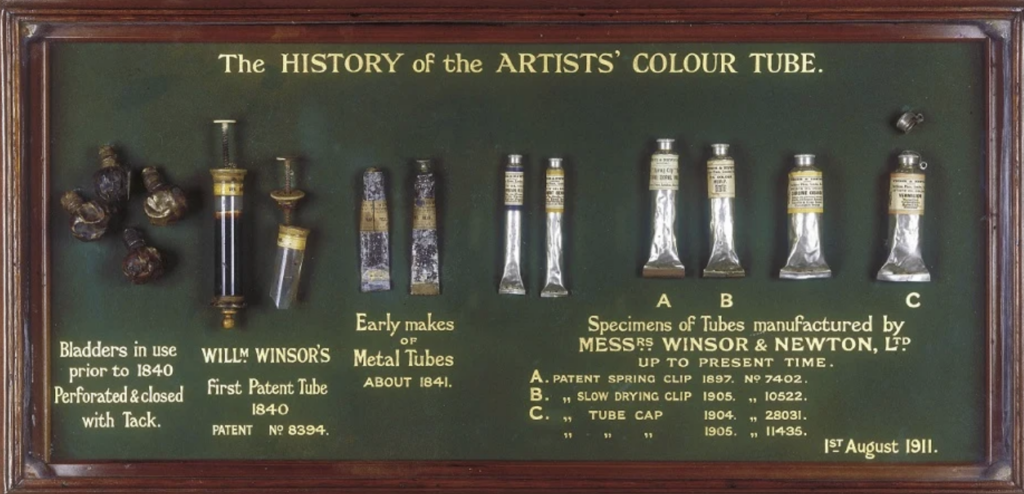
The technology was paint tubes.
These weren’t adopted immediately, because the tin tubes were more expensive. They weren’t adopted by everyone, because studio painters didn’t necessarily need them.
But when you wanted to paint outside, in the light, from life swirling around you, you needed something other than a pig bladder that you poked a hole in and that would often just randomly explode in your bag, coating everything with paint.
Do paint tubes count as technology?
I’ll let Merriam-Webster tell you:
“Technology is the practical application of scientific and conceptual knowledge to solve human problems, accomplish tasks, or manipulate the environment. It includes both tangible tools—like machines, computers, and hand tools—and intangible methods, such as software, systems, and engineering practices.”
Paint tubes allowed for adoption of further technology: synthetic pigments developed by French chemists.
Suddenly, painters could take multiple colors outside on the go, without worrying about them drying out, so they could paint rapidly changing conditions like the gorgeous sunrises and sunsets many of them are known for.
Calming the Fears of Imperfection
The École des Beaux-Arts (School of fine arts) in Paris was training ground zero for artists. And what they taught was more or less photorealistic painting and classical design.
Emile Bernard, a post-impressionistic painter was expelled for “stylistic failure.”
That show that the Impressionists were kicked out of? It was the Salon hosted by the École des Beaux-Arts. Full of hundreds of paintings that looked the same.
Below: Charles X Distributing Awards to Artists for the Salon of 1824. An 1827 painting by François Joseph Heim, now in the Louvre.

Katie, you work in GARDEN MARKETING, why so much art talk?
I write about art so much these days because making art has made me braver.
How? Making art is making something from nothing (so is gardening). It is a series of experiments (so is gardening). It is a willingness to try something and possibly fail and have to try again (so is gardening).
Making art gives me courage. Every time I try and succeed, every time I try and learn something, I build resilience. I also lower my stress, and make myself healthier.
There’s nothing that being a business owner requires more of than courage and a way to relieve stress.
I teach a lot of art classes because it’s fun for me, and teaching people how to watercolor or make cyanotypes or create garden vision boards allows me to study the people.
I spend hours and hours with YOUR customers watching them:
- Interact with unfamiliar materials that behave in unexpected and uncontrollable ways
- Make something out of nothing
- Being afraid of being judged
- Get frustrated by trying and failing
- Get excited by trying again and succeeding
- Attempting to be perfect, to create the picture they have in their heads, the first time they try.
All things that happen when you attempt gardening.
By teaching art and craft classes, I spend a LOT of time figuring out how to make people less afraid of uncertainty and more willing to embrace it in the moment. (In the moment is important, because if your customer is afraid to buy something at the point of purchase because they think they’re gonna kill it, you lose them. If they’re afraid to let you install the meadow they’ve always been wanting because they’re afraid of what people are going to think, you’ve lost them.)
Because we live our lives on social media, everything is a performance or at least that’s what it feels like, and the fear of the shame of failure and the whole world witnessing it has broken our sense of adventure.
Overscheduled and overwatched kids don’t know how to do things without someone explaining everything step-by-step the whole way.
And, even with all of our education that we provide customers, we still can’t stand over them every time they need to decide whether to prune a branch or leave it in place.
They have to be brave enough to do it themselves.
Once you have what you need to survive, there’s a chasm between surviving and thriving and businesses that I work with are often on the other side of that chasm, offering the thing that makes life exciting.
And they are offering it to people who are terrified of failing. Of not being an expert the first time they do something. Of killing a plant. Or plants. Or arranging flowers that look like crap or a container that dies in four weeks.
My clients are selling all day to people who are terrified of falling into the chasm of failure
So how do you build a bridge across?
To me, that bridge is the sharing of the process, the experimentation, the play, the analog.
I think the reason that generative AI programs are so popular (beyond overworked marketers) is that when a machine comes along that with a click of a button will produce a slick uncanny Valley facsimile with no work, no fear of failure (though we know that isn’t true because the “creations” are often slop and hallucinations, see above), it feels like relief.
You can skip the uncomfortable part of having to ask somebody else for an answer.
You can skip the shame of not knowing.
You can skip having to talk to somebody and maybe be wrong or be corrected.
You can shorten the length of looking at a blank page from minutes to milliseconds.
But you can’t generate a garden. You can’t generate a pastel painting. You can’t manufacture the feeling of a brush against paper or a hand plunged into potting soil.
So how does one build a bridge between the fear and the experience?
That is what is facing everyone working in retail and especially in garden retail today.
This is why I have spent the summer promoting lower-cost creative experiences at garden centers.
Not just because they’re popular, and they are.
Not because they can help you make money, because they will.
Not because they’ll help your TEAM build their courage muscles, but they can.
But because offering creative workshops your customers can associate you with success. To associate you with looking at a blank page and filling it. To associate you with encouragement and help with a project that is adjacent to, but not completely composed of keeping plants alive.
The École des Beaux-Arts preached conformity. So do most schools today. So does most everything today.
(I AM SO OVER THE KINDA CHIC INSTAGRAM TREND AND ALSO MISS ME WITH THE BUTTER YELLOW FONT.)
To survive and thrive in the face of economic pressures, one cannot put out slop.
One cannot afford to remain undifferentiated from the pack.
One has to figure out how to sell to people who are afraid of trying.
What I’m encouraging you to do is to provide ways to help your customers (and your teams) to build their courage, find their bravery, and do it in low-stakes ways.
This is especially true of doing team building creative activities like vision board making because THEY ARE NOT SUPPOSED TO BE GOOD AT GLUE STICKS. Their knowledge, cred, and standing are not on the line. Everyone starts from the same place. They can build resilience together when they do creative things together that none of them are particularly “good” at.
The impressionists KNEW that in order to have a different world, they had to create it themselves.
If we want a different world, we have to create it ourselves. We need to see something beyond what the machines can predict.
We need to use the new technology in ways that build our businesses, just like the Impressionists used paint tubes. So use it for sorting data, making tables, identifying patterns.
And we need to use the time we got back from that reporting and that analysis and go make something. AI can be our paint tube: letting us save time in some parts of our business so we free up time in other parts.
Let’s not outsource the painting to generative AI. Let’s outsource the tubes.
Need more encouragement to make stuff and think? Here’s some. (And here are the caveats.)
Activate Your Imagination
This summer and Fall I’m on a grand tour of Imagination Activations, inviting you to tap into your creativity so you can help your staff and customers tap into theirs.
Here’s where you can find me:

Garden Center Conference & Expo in Nashville, TN: August
1. Overview of hosting creative experiences at 9:00 am. (Open to all registrants.)
2. Immersive workshop on how to make and teach creative experiences (This is NOT your typical conference session.) This is SOLD OUT and my Aunt Jan is coming to help me. Hooray!

Farwest in Portland, OR: August
1. Hands-on Creative Experiences (Make your own stuff & learn how to lead Garden Vision Boards and paint-a-houseplant-trellis class (thank you Treleaf for the box o trellis!) Wednesday, Aug 26 at 12:30 in room B110.
2. How to Upsell Existing Customers with Engaging Email. Thursday, August 27 at 12:30 in room B110.
Both are open to all registrants with education passes.

Green Industry Show & Conference: Westerner Park in Red Deer, AB. Canada
Keynote: Developing & Using a Point of View for your Business
Sessions:
1. Managing & Marketing Events to Reach Max Capacity
2. New Customer Onboarding to Make More Sales
In Print — Meet Your Makers and DIY Tech Troubleshooting
My July Green Profit article is part two of a series about creativity: CLICK HERE TO READ IT


My June Green Profit column is all about how to DIY your tech troubleshooting. CLICK HERE TO READ IT LOTS OF GREAT TIPS!


Handy Links
Each newsletter always has a mix of fun and functional links.
How resource strapped businesses can improve marketing. (There are a LOT OF ADS but there are some good points here.)
A VERY FUN, VERY EASY Watercolor practice/artwork project. (FB video.)
How Chat GPT actually picks sources. (This is SUPER technical.)
Really great info on being memorable to customers.
How 10 minutes of drawing can reset your nervous system (AND YOU DO NOT HAVE TO BE GOOD AT IT JUST PICK UP A FRICKIN PENCIL ALREADY.)
REALLY GREAT Instagram account to follow re: how creative activities make us smarter and healthier.
I hit “send” before I got on a plane so all typos and broken links are entirely my own. I tried, y’all.
The third article in the summer creativity series hits Green Profit in September, and I got to talk to two awesome, new-to-you garden centers AND the ever fabulous Katie Dubow about how all of this relates to the 2027 trends, which will also be available for download from the Garden Media Group website in September.
We’re starting to book for fall projects . (ASDJFLSKDJFKLSADF HOW IS IT ALMOST TIME FOR THAT?) and we WILL run out of space. (This is not false scarcity. We legit can only take so much work.) So grab a discovery call and we’ll chat.
See you soon!
Art PS
Please enjoy 100 people making stuff at the same time at Cultivate! Garden vision boards, flower hammering, trellis painting, watercolor collage, and air dry clay. A great time was had by all!